Jon Carpenter, former publisher and owner of Evenload Books in Charlbury, has kindly given us a limited supply of A History of Spelsbury by Elsie Corbett. We are selling them in aid of Spelsbury Church at a discounted price of £10. If you would like to purchase a copy, please contact us by clicking here.
A History of Spelsbury Including Dean, Taston, Fulwell and Ditchley by Elsie Corbett
The history of the parish of Spelsbury (which includes the hamlets of Dean, Taston and Fulwell and the great house and estate at Ditchley) was written by the Hon. Elsie Corbett and first published in 1931, but Miss Corbett continued to work on the history of the parish and a revised edition – reproduced here without the plates and with a few corrections by the Charlbury historian, the late Lois Hey – appeared in 1962.
Ditchley was purchased in 1583 by Sir Henry Lee, whose descendants lived there until 1933. But if the parish has a claim to fame today, it is as the birth and burial place of John Wilmot, second earl of Rochester.
St Nicholas Church, Chadlington, Oxfordshire, OX7 3LX
Come and hear the Reading Phoenix Choir, internationally acclaimed choir, sing a varied and beautiful selection of choral music at St. Nicholas’ Church in Chadlington this Saturday. The choir will be singing a range of music to include works by Parry, Morley, Rachmaninoff and Billy Joel. The concert starts at 7.30pm and tickets are priced at £10 (£5 for under 16s). We hope to see many of you there!
A coal-fired power station. “massive CO2 extraction’ costing trillions in needed in order to avoid a runaway temperature rise, says a new paper. Photograph: Florian Gaertner/Photothek via Getty Images
Creationtide came to an end this week and Climate Week runs from October 8th to Sunday 16th. The link between the two is easily made. If we are to respect God’s creation then climate change and all it entails must be must be uppermost in our minds.
But ‘creation’ doesn’t just mean the natural world, or if does then we are part of it! We are created beings with a responsibility to all creatures and created things, be they sentient or not, and it is probably not too odd to start with our responsibility to ourselves. How many of us take care of our own wellbeing with as much diligence and concern as we do for our cars, pets or gardens? If God created us to enjoy and be actively concerned for the world, we’d better start by making sure we’re not running to fat and putting extra stress on our hearts: otherwise what use will that be to God?
Then when we look around us we will see a beautiful created world which also needs restraint, extra care and compassion. What use would be a world which is also over-stressed and liable to collapse? Which is true at the local, the national and the global level, none of which can be taken for granted. Small steps as well as grand gestures and serious change in political priorities will be required if we are to change direction as a 21st century world with 20th century habits. As the Bishop of Salisbury has memorably said, There is no Planet B!
We’ve all heard of the Paris agreement – which, thank God, was ratified this week by enough ‘Parties to the Convention’ for it to come into force on November 4th. And there were important steps forward in Montreal this week on emissions from international aviation. In Witney this month we will elect a new MP: how aware of environmental issues will he or she be? Some of us were at Kencot Solar Farm this week for a photo opportunity organised by Christian Aid to try and influence our new representative at Westminster.
But our own daily actions all make a difference, to us as well as to the air that our neighbour breathes, and cumulatively to the world we share with our international neighbours near and far, as well as to our own generation and the next and the next. Could we possibly consume less, use less fuel, throw less away? Could we do more to influence the world around us, the people and politicians, and the atmosphere we all share? You can read about ‘carbon offsetting’ on local firm Climate Care’s website which also gives tips on how to reduce your carbon footprint.
Creationtide, a Church season initiated in 1989 by the Orthodox Church and since adopted by Anglicans and Catholics, began on September 1st with the World Day of Prayer for the Care of Creation and it runs throughout the month until October 4th. Then on 8th October begins Climate Week – a ‘week of action’ initiated by the Climate Coalition which includes over 100 organisations, from Christian Aid to WWF ( https://weekofaction.org.uk/about/). Continue reading For the love of … God’s creation→
In May 2009 the Bishop of Dorchester founded the Fellowship of St Birinus, as a way of acknowledging people who have given exceptional service in some way to their church and community over a number of years. St Birinus was the first Bishop of Dorchester from the year 634 to 649 A.D.
Last Sunday, in the beautiful setting of Dorchester Abbey, a special service of Evensong was held for the Fellowship of St. Birinus at which 50 new members of the Fellowship were admitted by Bishop Colin. We are delighted that this year three members of the Chase Benefice were invited to receive this award:Elizabeth Llewellyn-Smith, Rosy Nixon and Ken Wakefield in recognition of their service to the Benefice and wider church.
Pictured below are Elizabeth and Ken with Bishop Colin. As Rosy was unable to attend the service we will mark her nomination at a forthcoming service in the Benefice. We send them all our warmest congratulations and thank them for all that they do.
The Font at Spelsbury decorated for a recent wedding
Sunday 4th September was a Red Letter Day in the Chase Benefice when over 50 people from all our parishes gathered in Spelsbury Church for the Baptism of one of our adult congregation. Despite the lead having been stolen from the roof of Spelsbury Church two weeks before, nothing could take away from the joy of the occasion as we welcomed Ilona into the family of Christ’s church. During the service Ilona gave a moving testimony of her faith and as we stood around the Font after her Baptism the prayers of intercession were led by two of our young people who will be Confirmed with her in October. It was a powerful and moving service which will live in our memories for a long time.
In a chapter about ‘Soul-shaping’ in his book The Shape of Living, David F Ford quotes a poem called ‘Revelation’ by Micheal O’Siadhail (pronounced ‘o-shale’). Ford’s theme is the secrets of intimacy and he says: ‘In intimate relationships it is constantly surprising that the deeper we become involved the more mysterious the other can seem.’
In the poem O’Siadhail describes a moment after twenty-one years of living with one ‘stranger and lover’. The sense of the intimate yet mysterious can be explored on several levels and we used this poem as a springboard for our short time of meditation at the July MMM (Mid-month Meditation, third Wednesday, Ascott Church). And as Ford comments: ‘We are secrets to ourselves, let alone to another.’
Our train gains ground in the evening light.
Among the trees the sun catches in its fall
Glints and anglings of a stone in a distant gable,
A broadcast of facets, one and infinite.
I glance at you. There’s so much unexplained.
Plays of your light keep provoking my infinity;
Already something in your presence overflows me,
A gleam of a face refusing to be contained.
How little I know of you. Again and again
I’ve resolved to be the giver and not the taker,
Somehow to surpass myself. Am I the mapmaker
So soon astray in this unknowable terrain?
Twenty-one years. And I’m journeying to discover
Only what your face reveals. Stranger and lover.
David Ford’s book subtitled ‘Spiritual Directions for Everyday
Life’ (Canterbury Press, 2012) has been a source of inspiration for Wychwood Circle’s discussions in Milton under Wychwood this year. On November 6th at 7pm (not October 2nd as previously announced) we will focus on chapters Three (Power, Virtue and Wisdom – the Shaping of Character) and Four (Secrets and Disciplines – Soul-shaping). All are welcome. http://www.wychwoodcircle.org
From tiny hamlets to our biggest cities, people across the Thames Valley may be feeling unsafe. Those who for weeks, months, years, decades, or a lifetime have made their home here, now feel unwelcome. Those of us who belong to minorities – particularly ethnic and religious minorities – feel a sense of heightened visibility and enhanced vulnerability. The recent escalation of verbal and physical violence in the wake of the EU Referendum is clearly implicated, and must be challenged.
We come together as people of all faiths and of no particular faith, to stand shoulder to shoulder in solidarity with one another, and with a clear message: in diversity is life; in diversity is growth; in diversity is transformation and creativity. We celebrate the multiple communities of faith and ethnicity that vitalise and enrich our civic, commercial and political life, our arts and our culture. We rejoice in our European identity, our wider international links and our global citizenship. We recognise too that much diversity, especially in our rural areas, is hidden, and will remain so whilst insecurity is allowed to have the upper hand. This is the case even though individuals from minority communities may feel a sense of heightened visibility and risk in rural contexts.
With the power that we have, and the resources at our disposal – we commit to meet hatred with love, confusion with hope, anger with peace and fear with joy.
The ‘love your neighbour’ campaign is owned by us all and seeks to draw people together and to believe the very best for our region.
So go… know your neighbour… love your neighbour.
Concerned? What are you doing? Contact Jo Duckles to share your story.
A Prayer for #loveyourneighbour
God of diversity,
We are fragile, insecure. We doubt our loveliness and our worth. Conflicted within ourselves, we compete, imposing our will on others, trying to outdo and to put down. We fight, creating outsiders and insiders – us and them.
Lord, we confess our part in creating conflict; our collusion with abuse; our failure to challenge the principalities and powers.
But we know that you meet us in unexpected places. That you invite us to find you in the people we write off; In places we fear and reject; in experiences we shy away from.
When we avert our eyes in discomfort, you fix our gaze. When we flee in terror, you invite us to return – to fear not. When we grow cold and inert, you touch us and bring the warmth and energy back.
Ignite in us a love for our neighbours and a passion for justice. Give us hearts that listen, souls that attend to you, minds that reflect, constantly, on your ways and your will. Help us to know you, forever, anew.
No-one knows just how many trees the Church of England has on its land. It has some 10,000 churchyards, and many often provide the only, ‘green lung’ within a community and rare habitats for a wide range of biodiversity.
The Church is responsible for a large number of trees which, like churches, need managing. The often great age of churchyards, and the long term protection they offer, means many of these trees are particularly important, and others have the potential to become so. The longer protection offered by churchyards means they often contain ‘veteran’ trees – those with ancient characteristics – and as such hold particular importance ecologically and culturally. This natural heritage is often managed by people with little specialist arboricultural or interpretation experience.
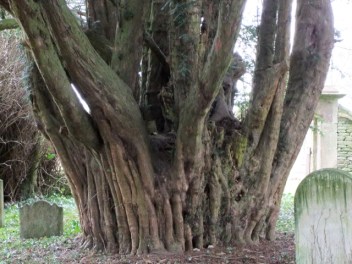
Yew tree in Heythrop Old Churchyard
Whilst churchyard yews are well known for their great age, there are many other species which provide a wealth of value to local communities. They may hold the secret to fighting threats to trees such as ash dieback and those affecting chestnuts, elms and oaks suggests David Shreeve, Environmental Adviser to the Archbishops’ Council. “If you’ve a variety of elm for example, which has not been affected by disease, perhaps there is something special about them that make them resistant,” he explains. “Churchyards may be the Noah’s Ark for trees.”
Two free churchyard trees conferences supported by the Heritage Lottery Fund are being held this autumn. Aimed at archdeacons, clergy, churchwardens, DAC Secretaries and Diocesan Environment Officers, friends groups, tree officers and all those involved in the care of churchyard trees. They will promote greater awareness of the importance of churchyard trees and encourage maintenance, future growth and interpretation with the support of the community.
The conferences will be held in Liverpool Cathedral on 6 October 2016 and St John’s Waterloo on 2 Nov 2016 and feature leading churchyard and arboriculture experts who will discuss the support and management churches can use to protect the future of churchyard trees.
Both events are being organised by The Conservation Foundation in association with the Church of England’s Environmental Working Group, Mission and Public Affairs, Cathedrals and Church Buildings along with Caring for God’s Acre and The Charter for Trees, Woods and People.
Those interested in attending for the free conferences can register at:

 The history of the parish of Spelsbury (which includes the hamlets of Dean, Taston and Fulwell and the great house and estate at Ditchley) was written by the Hon. Elsie Corbett and first published in 1931, but Miss Corbett continued to work on the history of the parish and a revised edition – reproduced here without the plates and with a few corrections by the Charlbury historian, the late Lois Hey – appeared in 1962.


 In May 2009 the Bishop of Dorchester founded the Fellowship of St Birinus, as a way of acknowledging people who have given exceptional service in some way to their church and community over a number of years. St Birinus was the first Bishop of Dorchester from the year 634 to 649 A.D.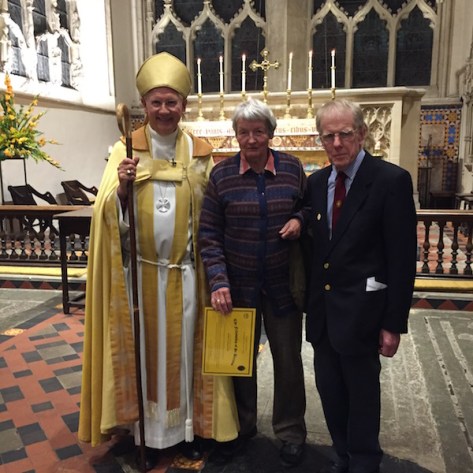


 Chase Benefice